
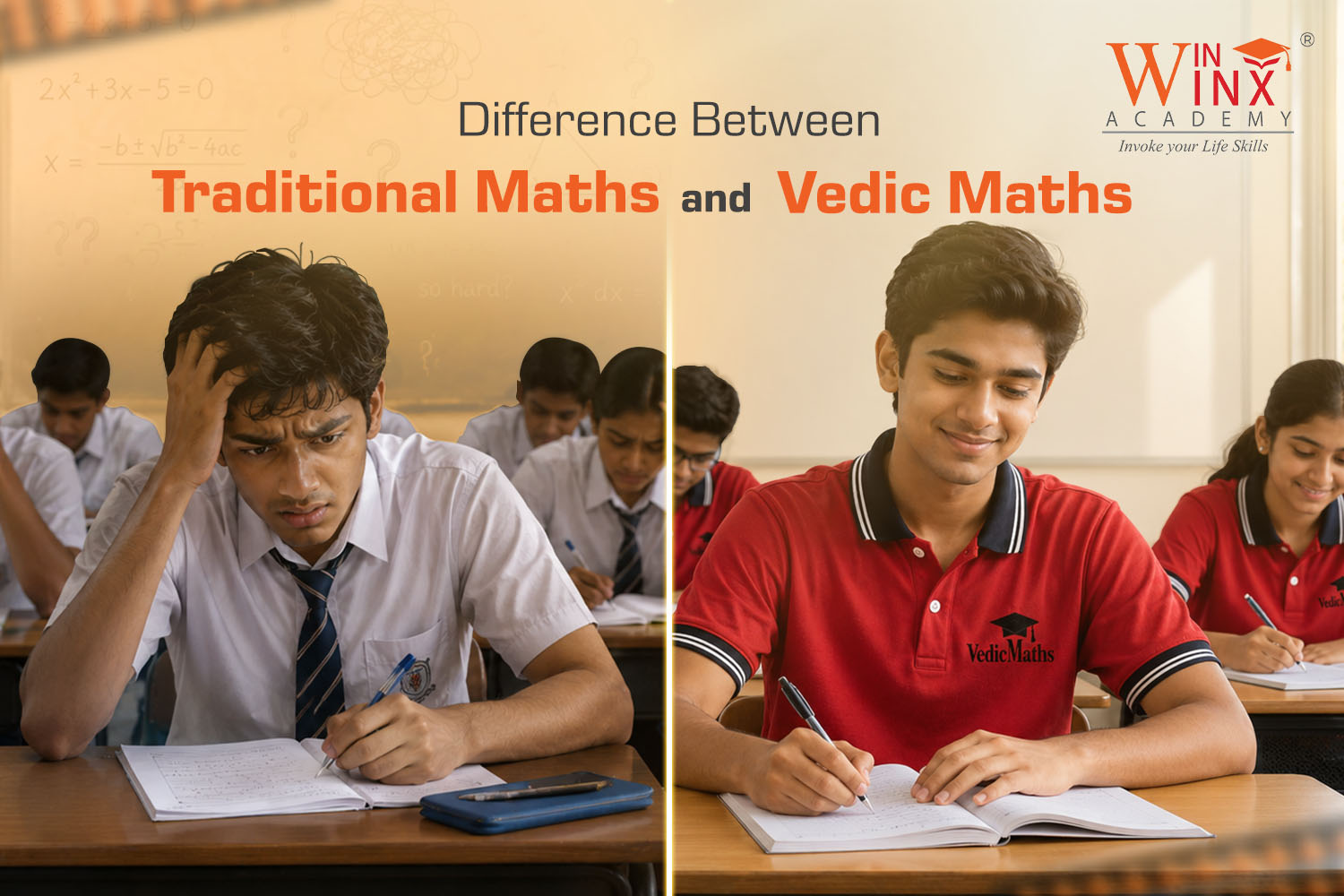
- Maths that are taught the traditional way help students understand mathematical concepts;
- They also help the students develop logical reasoning abilities and problem-solving skills.
- Traditional Maths is very useful in standard schooling.
- Vedic maths is useful, especially in competitive and aptitude tests.
- Both traditional and Vedic Maths will help students understand the mathematical concepts and enhance their confidence.
Traditional Maths vs Vedic Maths
Mathematics is one of the most important subjects in a student’s academic career. Mathematics aids the development of logical thought, problem-solving, and analytical skills, all of which are usable outside of academia.
The development of interest in Vedic Mathematics can be attributed to the evidence that students who apply Vedic methods show greater speed and accuracy in arriving at answers than students who follow standard practices of Traditional Maths.
Both Traditional Maths and Vedic Mathematics attempt to solve complex mathematical issues using methods that allow students to answer accurately, but the manner of instruction and the applicability of the respective methods represent huge differences.
What is Traditional Maths?
Traditional Maths is the name given to the standard method of instruction used to teach Mathematics in schools and institutes of learning throughout the world. It is instructive for its structured curriculum focusing on the progression of topics based on student capacity; i.e., it requires students to begin with the most basic ideas of arithmetic.
Standard formulas/algorithms are used in Traditional Maths, whereas a student gets to learn and apply these standards to perform calculations step by step, for logical thinking and reasoning. It forms the baseline of our modern education system and is required for success in it.
What is Vedic Maths?
Vedic Mathematics is a group of techniques and shortcuts that are based on ancient Indian Mathematics. It can assist students in doing simple methods of calculating faster than traditional techniques by using simple formulas and ways of thinking. Through Vedic Mathematics, students do not have to complete tedious calculations with lengthy steps because they can simply implement quick, memorized methods of calculating.
For instance, Vedic Mathematics can help students calculate multiplication, division, square root, cube root, percentages, etc., very quickly. Many schools and tutoring centers are beginning to teach Vedic Mathematics, so that students can learn a truly marvelous technique that will boost their confidence in mathematics and make them faster.
What Makes Traditional Maths Different from Vedic Maths
1. Learning Approach
- Traditional Maths tends to explain ideas in a more step-by-step kind of order.
- Students understand the logic behind each mathematical action, and then they slowly develop stronger abilities.
- Vedic Maths, in contrast, leans more towards mental computation and shortcut strategies.
- Rather than writing out each separate step, students usually figure the answers in their mind, often by using small and simple patterns, or what feels like “rules of thumb” that repeat.
2. Calculation Speed
- One of the most obvious differences is speed.
- Traditional Maths generally requires a lot of steps to complete, with the numbers getting bigger.
- With Vedic Maths, the number of steps is reduced, and students are able to solve the computations very quickly.
- As a result, it can be extremely helpful when it comes to competitive exams that require both time and accuracy.
3. Problem-Solving Method
- In Traditional Maths, students typically follow rigid formulas and methods that are taught in textbooks.
- Vedic Maths offers several ways to solve the same question.
- It helps students pick the easiest path, focusing on the exact numbers, and not just applying one set routine every time.
- This flexibility often makes the Math feel more engaging and less mechanical.
4. Mental Calculation Skills
- Traditional Maths frequently depends on written work.
- Vedic Maths pushes learners to calculate mentally, which can improve memory, focus, and self-belief.
- Gradually, students become comfortable working with numbers without leaning too much on calculators, even when the problems look “big”.
5. Curriculum Coverage
- Traditional Maths generally covers every area needed for school learning.
- This includes algebra, geometry, statistics, calculus, and probability too.
- Vedic Maths mainly concentrates on arithmetic work and numerical operations.
6. Examination Benefits
- Traditional Maths is needed for school board examinations because students are expected to show full working and prove conceptual understanding.
- It sometimes has to be very methodical, even if the final answer is rapid.
- Vedic Maths plays a crucial role in competitive exams like aptitude tests, banking exams, or entrance tests because solving questions quickly can boost overall scores.
7. Student Engagement
- Many students think Traditional Maths is quite difficult because the arithmetic can turn lengthy, repetitive, and a bit tiring.
- They end up feeling stuck, even when they know the basics.
- Vedic Maths brings engaging tricks and swifter approaches that make learning mathematics more interesting and enjoyable.
- Students usually build more confidence after mastering these methods, and they start believing that practice actually pays off.
Advantages of Traditional Math
- Traditional Maths is considered the backbone of math education, for several reasons, but it is mostly given importance as it builds up something real, not just quick answers.
- It helps students get a solid sense of how ideas connect, not only remember a shortcut, but also move on.
- Learners gain a deep understanding of mathematical principles, rather than merely memorizing little tricks.
- Areas like engineering, science, finance, and data analytics really rely on conceptual knowledge, which Traditional Maths develops through steady learning.
- The curriculum is recognized worldwide, so it becomes easier to keep progressing academically, and it also fits well with higher education expectations.
- Students practice structured reasoning and systematic problem-solving habits that go beyond mathematics itself.
- In a way, it trains the mind to think in order and check assumptions, again and again.
Advantages of Vedic Maths
Vedic Maths brings in a bunch of special benefits that kind of match well with traditional learning and still feel a bit different.
- Faster calculations this is one major thing. Students solve arithmetic problems quickly, so less time goes into those long drawn calculations.
- Improved concentration happens too. When mental calculation methods are used, focus and memory get sharper, and it feels easier to stay on track.
- There’s also greater confidence. When students experience quick wins with calculations, they usually build a positive mindset toward mathematics, rather than getting stuck early.
- Better performance in competitive exams. These time-saving techniques let students attempt more questions and also improve accuracy within the limited exam time.
- And reduced calculator dependence. Students become more comfortable doing the sums in their heads, rather than relying on tools all the time.
Which Method is Better?
It is better to see Traditional Maths and Vedic Maths not as competition but as a complementary system. Traditional Maths gives conceptual clarity and also brings the academic groundwork you need later for higher education. Vedic Maths, on the other hand, sharpens speed, accuracy, and inner mental agility so the actual arithmetic feels simpler, and somehow less intimidating.
Learners who use both approaches often end up with the best learning experience, honestly. They grasp the mathematics concepts more deeply, while at the same time they train their mind to crack numerical problems quickly.
Final Thought
To conclude, traditional Maths and Vedic Maths each give useful advantages for learners. Rather than picking just one, students can gain most by mixing both styles, so to speak. A solid conceptual base along with brisk computation ability forms a more balanced mathematical mind, which later helps in school, competitive examinations, and ordinary day-to-day life. When learners accept both approaches, they can change mathematics, not only from something hard but also into a fun and satisfying experience.


0 Comments
Trackbacks/Pingbacks