
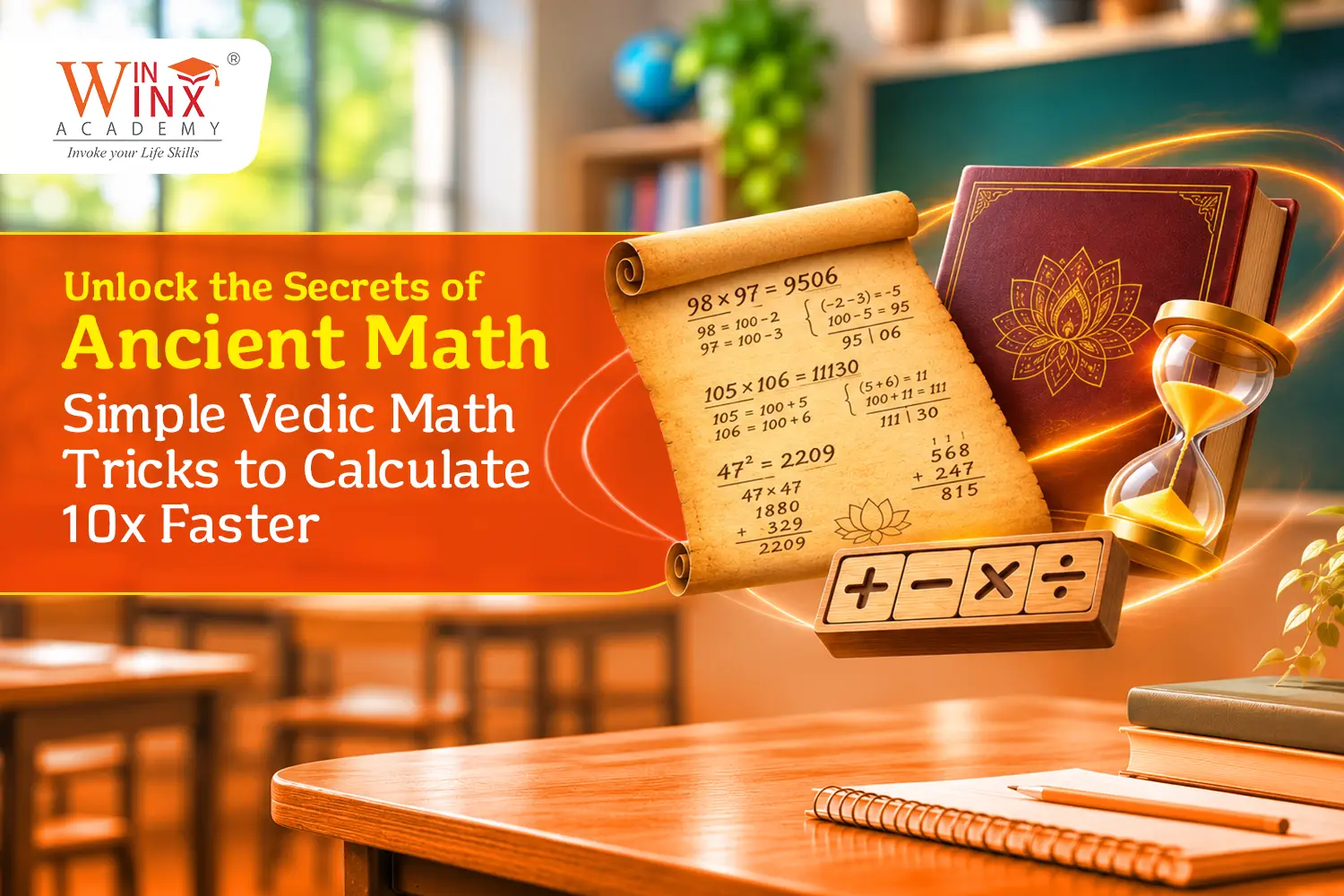
- Vedic maths tricks for fast calculation relies on recognizing patterns in numbers, turning long sums into short ones.
- A few simple Vedic math tricks can make a huge difference in how much time you spend on homework.
- Vedic mathematics multiplication tricks shine when the numbers sit near 10, 100, or 1000.
- Dividing by 5 or 25 takes about three seconds once you know the shortcut.
- Ten minutes of daily practice beats a long weekend session.
Picture a Sunday evening. Your child is stuck on a three-digit multiplication, and the page has turned into four rows of tiny numbers, a few rubbed-out carries and one very tired face. It’s 8:30 pm, and there’s still Hindi to finish.
Most of us have been there ourselves. Long calculations are slow, and in a timed test it’s also stressful, because every extra step is another chance to slip.
Vedic Maths offers another way in. Nobody can promise “10x faster” for every single sum, and we’ll be honest about that. But for the right kind of sum, a child trained in these Vedic mathematics techniques can finish in a few seconds what normally takes a minute. Let’s look at how, with examples, you can try at the dinner table tonight.
Where Vedic Maths Comes From
The name is derived from the Vedas, and the revival is due to Bharati Krishna Tirthaji, who compiled the method into 16 sutras in the early 1900s. Here, a sutra is merely a brief formula for one type of sum. But it’s not magical, though it seems so in the name.
The real differentiating factor is the order of thinking. Skills: School mathematics says: start from the right, carry, repeat. Vedic maths teaches you: ‘Look first’. Is the number near to 100? Does it end in 5? Is it only 11 x something? A surprising number of long sums are short sums in disguise.
ALSO CHECK – What is Vedic Mathematics? A Complete Guide
Basic Vedic Maths Tricks to Start With
Don’t begin with the clever ones. Start with three that give an instant payoff.
1. Squaring a number that ends in 5
Take 35². Multiply the first digit (3) by the next number up (4), which gives 12. Then write 25 at the end. The answer is 1225. Try 75²: 7 × 8 = 56, so the answer is 5625.
2. Multiplying by 11
Take 34 × 11. Keep the first digit, add the two digits in the middle, keep the last digit: 3, (3 + 4) = 7, 4. The answer is 374. When the middle sum goes past 9, as in 78 × 11, carry it over: 7, 15, 8 becomes 858.
3. Subtracting from 1000
Take 1000 − 467. Subtract every digit from 9, but the last one from 10: 9 − 4 = 5, 9 − 6 = 3, 10 − 7 = 3. The answer is 533. Shopkeepers have used a version of this for ages without calling it Vedic.
Vedic Mathematics Multiplication Tricks: Numbers Near 100
This is the trick that makes children’s eyes go wide. Take 97 × 96.
Both numbers are a little short of 100. 97 is 3 short, 96 is 4 short. Subtract crosswise: 97 − 4 = 93 (or 96 − 3, same thing). Then multiply the shortfalls: 3 × 4 = 12. Put them together: 9312. No carrying, no rows.
The same idea works when numbers are a little over 100. For 107 × 103, add crosswise (107 + 3 = 110) and multiply the extras (7 × 3 = 21), which gives 11021.
For bigger numbers where there’s no neat base, there’s the “Vertically and Crosswise” method. Take 23 × 14. Multiply the left digits (2 × 1 = 2). Cross-multiply and add (2 × 4 + 3 × 1 = 11). Multiply the right digits (3 × 4 = 12). Now work from the right: write 2 and carry 1 from the 12, then 11 + 1 = 12, so write 2 and carry 1 again, and finally 2 + 1 = 3. Read it left to right and you have 322.
Vedic Mathematics Division Tricks: Easier Than They Look
Children dread division the most of the four basic arithmetic operations, and a few helpful quick tricks will come in handy.
Divide by 5: Double and shift the decimal. 345 ÷ 5 becomes 690 ÷ 10 = 69.
Dividing by 25: Multiply by 4 and then divide by 100. 650 ÷ 25 becomes 2600 ÷ 100 = 26.
That’s because these two look too easy and that’s what makes them great for beginners. There are also full long division methods in Vedic Maths, but they require guided practice, and therefore are more suitable to be learned in incremental stages from a trainer.
ALSO CHECK – Amazing Benefits of Vedic Mathematics Classes
What to Expect from Vedic Maths for Fast Calculation
A fair warning, so you don’t expect miracles. These tricks work best on numbers with a recognisable pattern: near a base, ending in 5, multiplied by 11. On a random sum like 47 × 63, the saving is smaller, and that’s normal.
What does improve across the board is the habit of pausing to look at a problem. Children who practise this become quicker, and they also become more accurate, because they understand why the answer comes out right. It’s also useful later, in timed tests such as banking, SSC and entrance exams, where a few saved minutes decide how much of the paper gets attempted.
Practising at Home
- Pick one trick a week. Two tricks in one week and both get forgotten
- Time a small set of five sums and let your child beat their own record
- Ask them to explain the trick to you. If they can teach it, they know it
- Mix easy sums with one tricky one so the pattern-spotting stays alive
- Keep it ten minutes and stop while they still want more
Why This Matters
A sum looks frightening, and then it turns out to have a back door. Children remember that moment. For many, it’s the first time maths feels like a puzzle they can win instead of a wall they keep hitting. After a few such moments, they stop flinching at long questions and start hunting for the pattern. That is what these vedic mathematics techniques quietly do in the background of all the speed practice.
Final Thought
Start with just one trick tonight. Squaring a number ending in 5 is a good first one, as it takes about ten seconds and your child will want to show it off to the whole family. Winwinx Academy’s Vedic Maths programme is designed to be taught step by step, with practice that matches your child’s pace, if you want to find out Vedic maths for fast calculations step by step.
FAQs
- What is the age of initiation for children to learn Vedic Maths?
Children are likely to be able to start from the age of knowing basic addition, subtraction and tables. Simple tricks like multiplying by 11 can be tried even earlier, for fun.
- Is there any division sum in which vedic mathematics division trick is not applicable?
Not for every sum. The shortcuts for 5, 25 and a few other numbers operate immediately. The fuller methods are needed in other divisions; these can be taught in stages by a trainer.
- Will this cause my child problems in their school maths?
No. Children continue to learn the same way for exams. Vedic Maths is nothing more than providing some faster methods of calculation and practice for mental calculations that are used in daily life.


0 Comments