
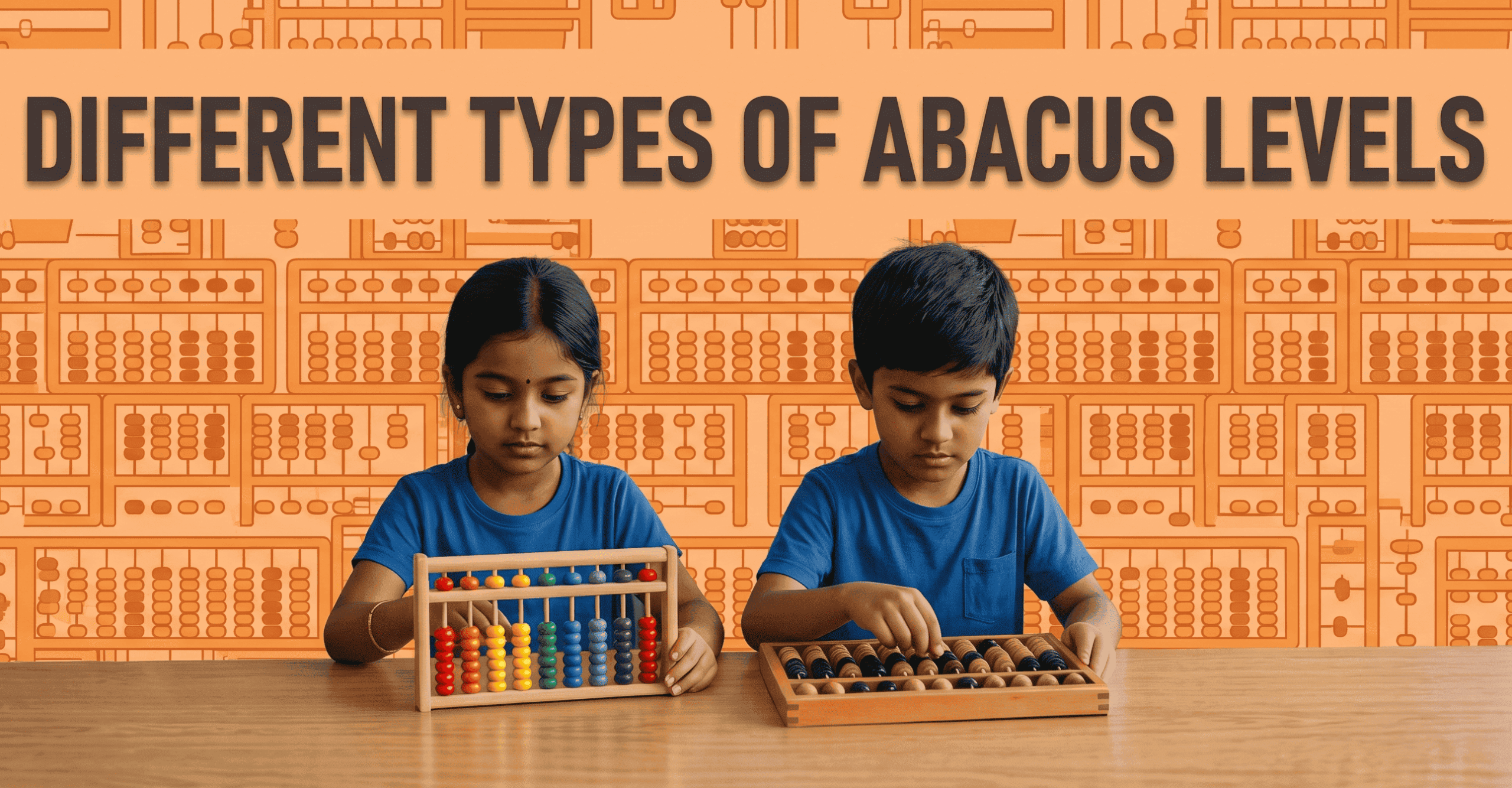
Abacus learning is usually divided into different levels or stages, with each level introducing students to new calculation techniques and gradually building their mathematical skills. From basic number recognition and bead operations to advanced mental calculations, each stage helps students develop greater speed, accuracy and confidence.
In this guide, we explain the different types of abacus levels, what students learn at each stage, and how they progress from using the physical abacus to performing calculations mentally.
What Are Abacus Levels?
The Abacus, a centuries-old calculating tool, has evolved into a powerful brain development aid for children. Today, Abacus Levels are designed not only for arithmetic calculations but also to enhance cognitive skills and mental agility. Abacus education is structured into different levels, each providing a deeper understanding of arithmetic concepts and enhancing mental calculation skills. In this article, we will delve into the various types of abacus levels available and highlight the comprehensive coaching services offered at Winwinx Abacus Academy.
How Many Levels Are There in Abacus?
The number of abacus levels depends on the curriculum or training program. Different abacus institutes may use different names and numbers of levels. Some programs may have beginner, intermediate and advanced stages, while others divide the curriculum into several graded levels. Instead of focusing only on the number of levels, it is more useful to understand what mathematical skills students develop at each stage.
Exploring Different Types of Abacus Levels and the Best Coaching at Winwinx Abacus
Beginner Abacus Level: Introduction to Abacus
The beginner level is where every young learner starts their journey with the abacus. At this stage, children are introduced to basic concepts such as:
- Structure of the Abacus: Understanding its components – beads, rods, and frame.
- Basic Operations: Learning simple addition and subtraction using one-digit numbers.
- Number Recognition: Familiarizing themselves with numbers through visual representation on the abacus.
Benefits:
This foundational level enhances confidence and sparks interest in mathematics by making learning interactive and tangible. Through Abacus Levels, children progress at their own pace while improving fine motor skills with bead manipulation.
Intermediate Level: Expanding Mathematical Skills
Once children grasp basic operations, they progress to the intermediate level where they tackle more complex calculations:
- Multi-Digit Arithmetic: Performing addition and subtraction with two or more digits.
- Introduction to Multiplication and Division: Learning these operations using a systematic approach.
- Mental Math Techniques: Encouraging kids to visualize calculations without relying solely on physical beads.
Benefits:
At this stage, students advance their critical thinking skills by solving problems more independently. The Abacus Levels at the intermediate stage foster a deeper understanding of mathematical concepts, benefiting them throughout their academic journey.
Abacus Advanced Level: Mastery of Complex Calculations
The advanced level is designed for those who have mastered intermediate skills and are ready for greater challenges:
- Advanced Operations: Engaging with complex multiplication (including multi-digit) and division problems.
- Decimal Numbers & Fractions: Introducing real-world applications of math beyond whole numbers.
- Speed Calculation Techniques: Training students to perform calculations quickly both on the abacus and mentally.
Benefits:
At this stage of Abacus Levels, students achieve proficiency beyond basic calculations, mastering problem-solving strategies applicable to real-life situations. This expertise enhances resilience and equips them for advanced math courses in school.
Competitive Level of Abacus: Preparing for Challenges
For those interested in taking their skills even further, competitive levels focus on preparing students for competitions or advanced assessments:
- Timed Challenges: Practicing under pressure helps improve speed and accuracy.
- Complex Problem Solving: Tackling challenging questions that require creative thinking.
- Group Competitions: Encouraging teamwork while fostering a healthy competitive spirit.
Benefits:
Engagement at this stage of Abacus Levels not only sharpens mathematical skills but also cultivates discipline, perseverance, and collaboration-essential qualities for success beyond academics.
How Long Does It Take to Complete Abacus Levels?
The time required to complete abacus levels can vary depending on the curriculum, class frequency, student practice and individual learning pace. Consistent practice is important because students need time to develop both calculation speed and accuracy.
Physical Abacus vs Mental Abacus
| Physical Abacus | Mental Abacus |
|---|---|
| Uses a physical tool | Uses mental visualization |
| Helps beginners understand numbers | Builds mental calculation ability |
| Beads are physically moved | Bead movements are visualized mentally |
| Useful during early learning | Useful at more advanced stages |
Coaching Services at Winwinx Abacus Academy
At Winwinx Abacus Academy, we offer comprehensive coaching services for all types of abacus levels mentioned above. Our experienced instructors are dedicated to providing high-quality training to help students excel in mental math and abacus operations. Here’s how our academy stands out
Personalized Instruction:
We tailor our coaching sessions to meet the individual learning needs of each student, ensuring that they receive personalized attention and support throughout their abacus training.
Experienced Trainers:
Our instructors are highly skilled and experienced in teaching abacus techniques to students of all ages. They create a nurturing and stimulating learning environment to encourage student engagement and progress.
Interactive Learning Activities:
We incorporate interactive learning activities and games to make abacus education enjoyable and engaging for students. These activities help reinforce concepts and enhance retention.
Progress Monitoring:
We regularly assess student progress and provide detailed feedback to track their development and identify areas for improvement. This ensures that students stay motivated and on track to achieve their goals.
Exam Preparation:
For students interested in participating in abacus competitions or exams, we offer specialized training and guidance to help them prepare effectively and perform their best on the day of the event.
Holistic Development:
Apart from focusing on mathematical skills, we also emphasize the overall cognitive development of students through abacus training. Our program aims to boost memory, concentration, creativity and problem-solving abilities

Abacus Levels – Winwinx Academy
Related Blogs
Exploring 7 Different Types of Abacus
A Complete Parent’s Guide to Abacus and Traditional Math Learning
Abacus Multiplication and Division Explained with Simple Examples
FAQ
- What are the different types of abacus levels?
Abacus programs generally divide learning into progressive stages, starting with basic abacus concepts and moving towards advanced calculations and mental arithmetic. The exact number and names of levels vary between programs. - How many levels are there in abacus?
The number of abacus levels varies depending on the curriculum or training program. Different institutes may divide their syllabus into different numbers of stages. - What is taught in the first level of abacus?
The first level generally introduces students to the abacus, numbers, place value and basic calculation techniques such as simple addition and subtraction. - What is the highest level of abacus?
The highest level depends on the specific abacus curriculum. Advanced levels generally focus on more complex calculations, speed, accuracy and mental visualization. - Can beginners start abacus learning?
Yes. Beginners can start with foundational abacus concepts and gradually progress through more advanced levels. - At what age can children start learning abacus?
The appropriate starting age can vary depending on the child’s readiness, learning ability and the curriculum. A suitable program should assess the child’s current level before assigning a stage.


0 Comments